
Ohio State and Oregon have the two biggest rosters in college football, and both are down to their backup quarterbacks. The SEC has 10 ranked teams. The Big Ten has just five. Depth is the difference.
On Saturday, the two most expensive rosters in college football meet in Columbus. Ohio State spends an estimated $51.5 million on its roster, and Oregon spends $51 million, according to The Athletic's 2026 estimates. No program in the Power 4 spends more.
Neither team will have its starting quarterback.
Ohio State's Julian Sayin hurt his throwing shoulder in the fourth quarter of the Buckeyes' win at Indiana on Oct. 17. Coach Ryan Day said he'd miss several weeks. Oregon's Dante Moore suffered a concussion against USC on Sept. 26 and isn't expected to play again this season.
A month ago, this would have been one of the biggest games of the year. Now Ohio State is No. 11 in the AP poll and Oregon is unranked. And the Big Ten has nobody else with that kind of money to pick up the slack.
The two biggest budgets, without their quarterbacks
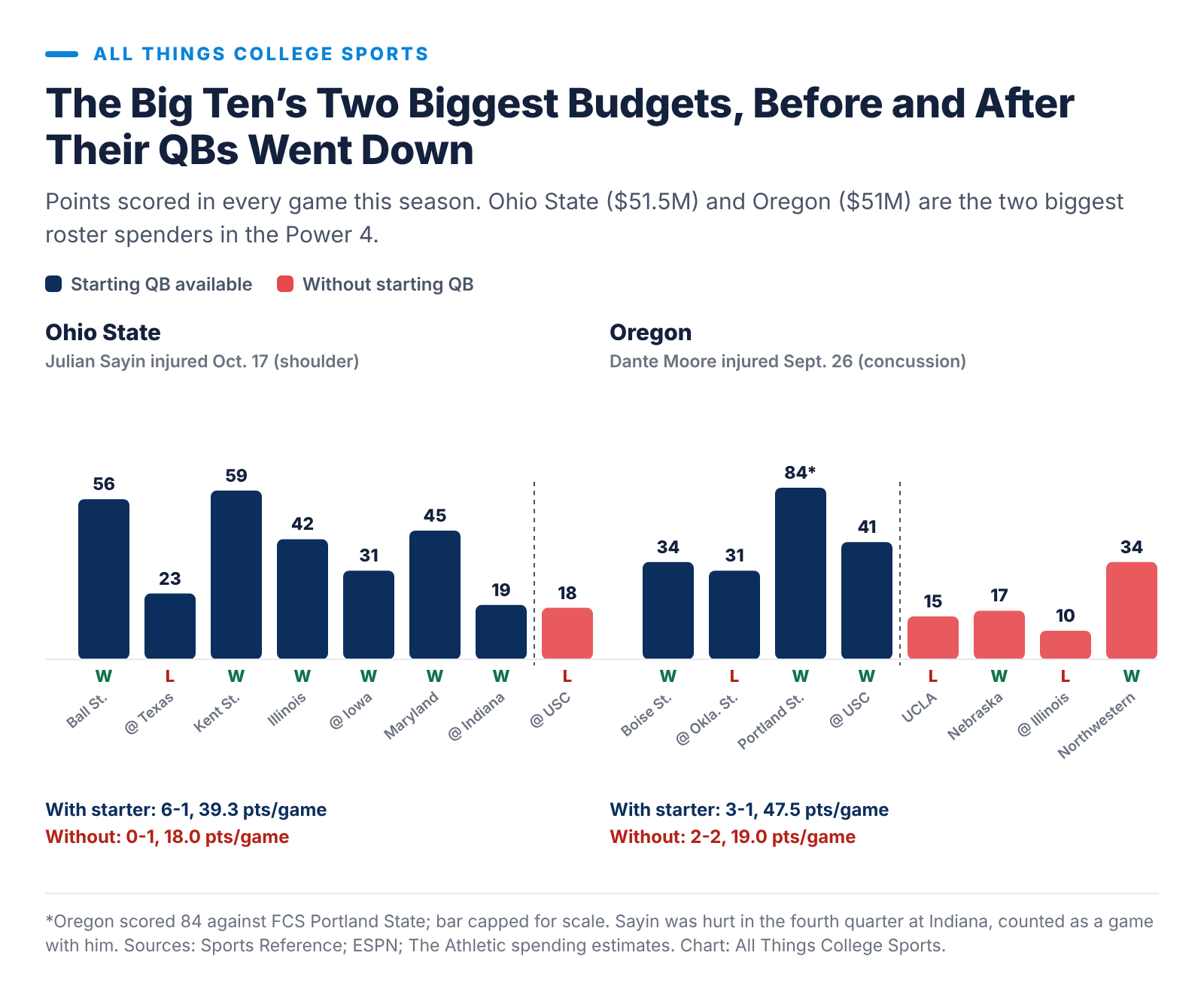
Before he got hurt, Sayin was completing 71.2% of his passes, with 17 touchdowns and two interceptions. Ohio State went 6-1 in games he started and averaged 39.3 points. In their first game without him, the Buckeyes lost 30-18 at USC and fell from No. 2 to No. 11.
Oregon's drop has lasted longer. With Moore, the Ducks went 3-1 and averaged 47.5 points, though that includes 84 against FCS Portland State. Without him, they're 2-2, averaging 19 points, with losses to UCLA and Illinois. Coach Dan Lanning fired his offensive coordinator after the Illinois loss.
One injury doesn't make a team's season. But these are the two programs that spent the most to make sure it wouldn't happen.
Ten SEC teams are ranked. Five Big Ten teams are.
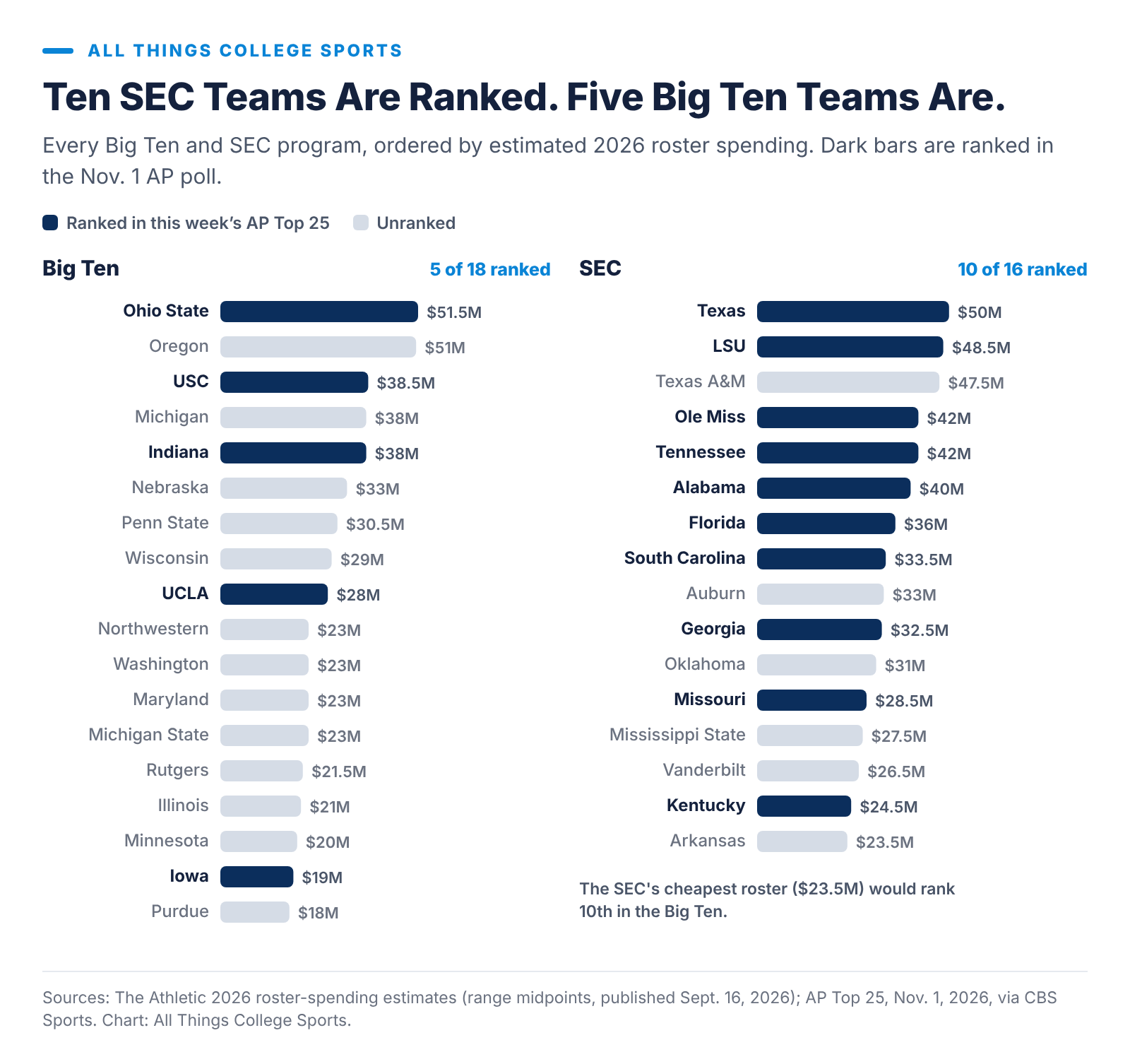
This week's AP Top 25 has 10 SEC teams in it: Georgia, Kentucky, Alabama, Texas, Ole Miss, LSU, Tennessee, Missouri, South Carolina, and Florida. That's 10 of the league's 16 programs.
The Big Ten has five ranked teams out of 18: UCLA, Indiana, Ohio State, USC, and Iowa.
Look at where the ranked teams come from. Every ranked SEC team spends at least $24.5 million, and the SEC's cheapest roster, Arkansas at $23.5 million, would rank 10th in the Big Ten. When Florida stumbles or Texas A&M falls apart, there's another $30 million to $40 million roster right behind it. Nine Big Ten programs spend less than any SEC team.
Indiana and UCLA are coached, not bought
The Big Ten's two best teams right now aren't its biggest spenders. They have two of the best coaches in the country.
Indiana (8-1, No. 6) spends about $38 million, 13th in the Power 4. Curt Cignetti took over one of the least successful programs in college football history and won the national title last season, going 16-0 and beating Miami in the championship game. The Hoosiers' only loss this season was 19-15 at home to Ohio State, the game in which Sayin got hurt.
UCLA (8-0, No. 5) spends about $28 million, 24th in the Power 4 and ninth in its own league. Bob Chesney arrived from James Madison, where he went 12-2, won the Sun Belt, and reached the College Football Playoff last season. In his first year at UCLA, they’re 5-0 in the Big Ten, including a 17-15 win at Oregon.
The rest of the league can't keep up week after week
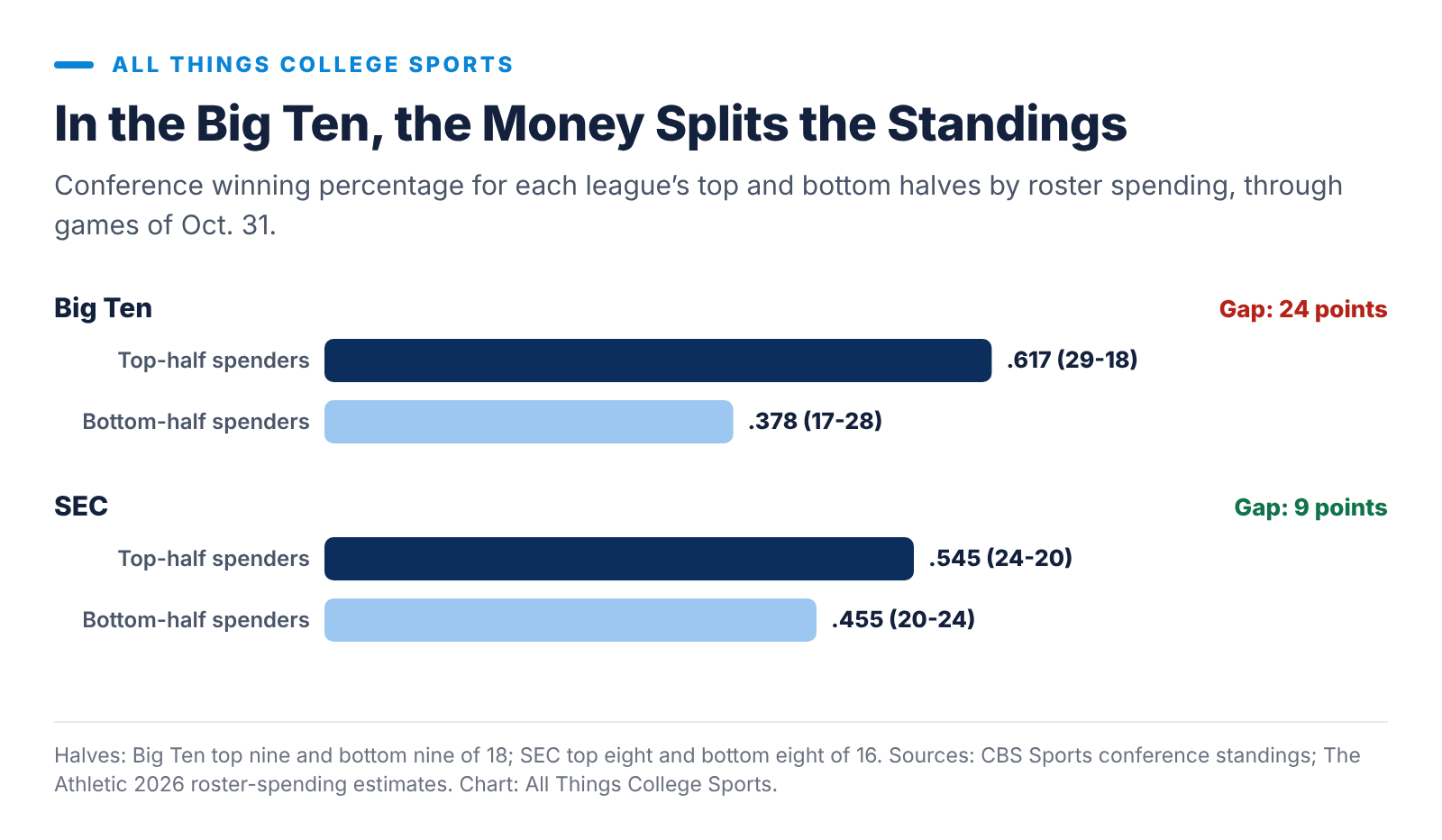
Split each conference in half by spending, and the difference is clear. The Big Ten's nine biggest spenders are 29-18 in conference play, a .617 winning percentage. The bottom nine are 17-28, a .378 mark. That's a 24-point gap.
In the SEC, the top eight spenders are 24-20 (.545), and the bottom eight are 20-24 (.455). Nine points separate them.
That's what depth looks like. Kentucky, the SEC's second-cheapest roster, is 7-1 and ranked eighth. Georgia, 10th in the league in spending, is No. 2 in the country. In the SEC, the program behind you can beat you, and the program behind that one can too.
The Big Ten's lower half doesn't have that. Michigan State and Maryland are a combined 0-10 in league play. Rutgers is 1-4. Penn State, which reached the playoff semifinals two seasons ago, is 1-4.
What it means
The Big Ten's ceiling is still as high as anyone's. Indiana won the last national title, and UCLA is unbeaten. But the league's depth depends on two programs spending more than $50 million, and when both lose their quarterbacks in the same month, the gap shows.
The SEC's money is spread out, so its ranked teams are too. That's why the SEC can lose a contender and still have 10 teams in the Top 25.
Saturday's game in Columbus still matters. Ohio State is 4-1 in the Big Ten and in the race for the conference title game. But it's a reminder of how thin the Big Ten's margin is. Two injuries and the league's two biggest rosters look ordinary, and nobody below them is built to take their place every week.
About the data: Spending figures are midpoints of The Athletic's estimated 2026 roster-spending ranges (published Sept. 16, 2026), covering revenue sharing and school- and booster-driven NIL. Rankings are from the AP Top 25 released Nov. 1, 2026. Conference records are through games of Oct. 31, per CBS Sports. Game results are from Sports Reference. Injury details are from ESPN. Spending halves: Big Ten top nine and bottom nine of 18; SEC top eight and bottom eight of 16. Coaching records are from Indiana and UCLA athletics and the Associated Press.