
The NCAA Tournament adds eight at-large spots this season. Our Bracket Buster Index ranks the 20 best teams outside the high-major conferences and identifies which ones are built to crash March.
Every March, somebody from outside the big leagues ruins a lot of brackets. Last season, five teams from outside the ACC, Big East, Big Ten, Big 12 and SEC won a first-round game: Gonzaga, VCU, Saint Louis, Utah State and High Point. VCU beat No. 6 seed North Carolina as an 11 seed. High Point knocked off No. 5 seed Wisconsin.
This season, the tournament grows from 68 teams to 76, and all eight new spots are at-large bids. That doesn't help everyone equally.
In a one-bid league, like the Big South or the Southland, nothing has changed. Win the conference tournament or go home. As we wrote in our look at roster spending, the bubble tilts toward the big spenders, and for a mid-major that doesn't win its league, the margin for error has barely moved.
The stronger leagues outside the power conferences are a different case. The new Pac-12 has three teams in Torvik's preseason top 60 (Gonzaga, San Diego State and Utah State) and can realistically aim for three or more bids. The Atlantic 10, Mountain West, and West Coast Conference are in a similar spot. In those leagues, a team can lose in its conference tournament and still have a résumé worth an at-large bid. For them, the eight new spots are a real opening.
So which teams are best positioned to take advantage? We built an index to find out.
How the index works
We started with the 20 highest-rated teams outside the five high-major conferences in Bart Torvik's 2026-27 preseason projections. Gonzaga, projected No. 8 in the country, is left out. It's a national title contender, not a bracket buster, and we treated it as a high-major in our earlier basketball coverage.
Each team was scored on four things, each measured from 0 to 100 against the other 19 teams:
Projected strength (50%): Torvik's preseason power rating, which estimates how often a team would beat an average Division I opponent.
Experience (20%): Torvik's roster experience rating.
Returning minutes (10%): the share of last season's minutes that are back.
March track record (20%): NCAA Tournament appearances plus tournament wins over the last five tournaments, 2022 through 2026.
Strength carries the most weight because good teams win in March. Experience and continuity matter because upsets usually come from older teams that know who they are. And a track record matters because programs that have been there before tend to get back.
The Bracket Buster Index
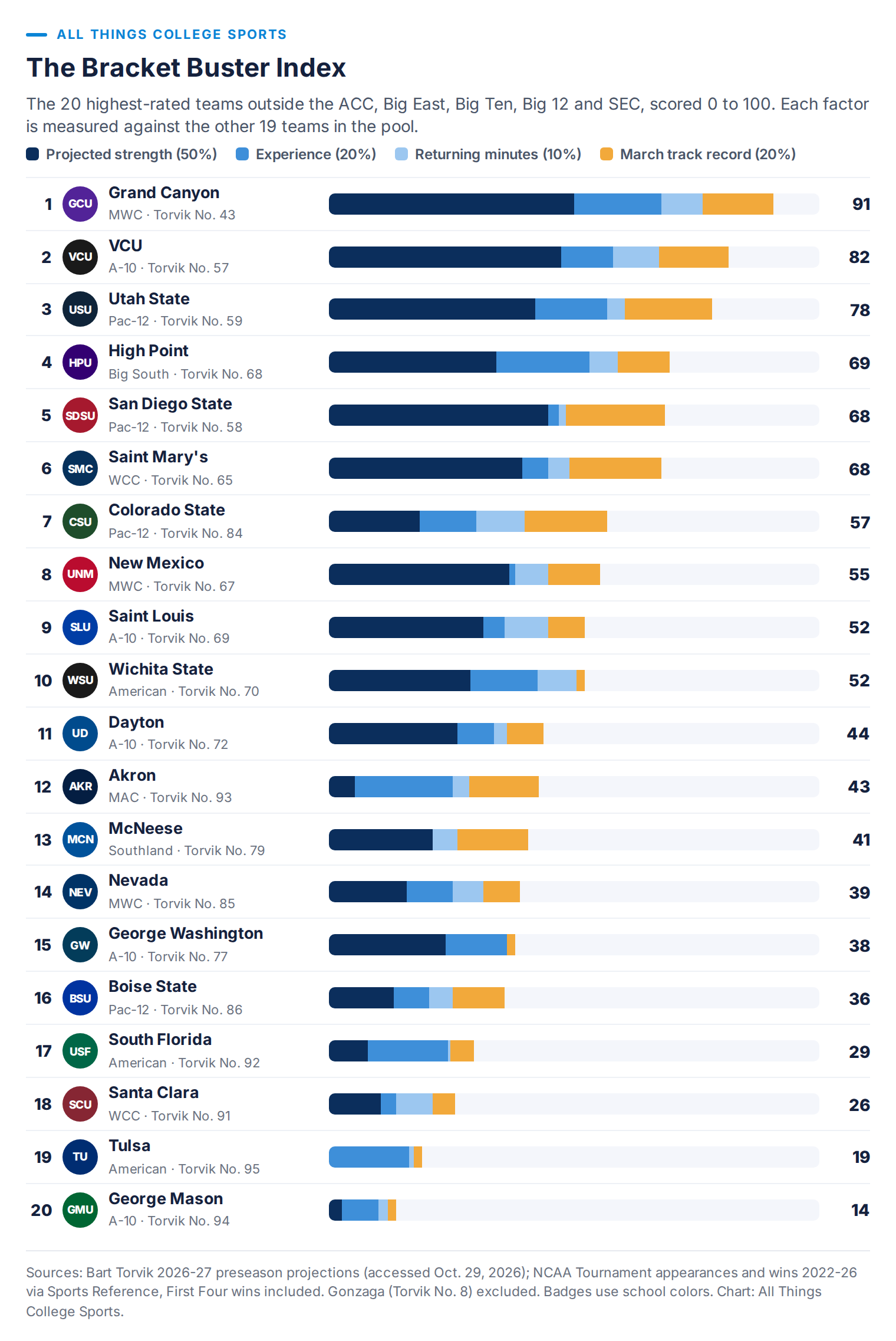
Grand Canyon is No. 1, and it isn't especially close. The Lopes are the highest-rated team in the pool (No. 43 nationally), Torvik projects them to go 25-6, and they bring back 49% of last season's minutes with one of the most experienced rosters in the group. They've been to three of the last five tournaments and beat No. 5 seed Saint Mary's in 2024.
VCU is No. 2. The Rams return 59% of their minutes, the second-highest share in the pool, from a team that won the Atlantic 10 tournament and beat North Carolina in March.
Utah State is No. 3. The Aggies have made four of the last five tournaments and won a first-round game in two of them, including last season's win over Villanova.
High Point is No. 4, and it's the one team in the top five that almost certainly has to win its conference tournament to get in. Torvik projects the Panthers to go 28-4 and 15-1 in the Big South. If they do, they'll arrive in March as the kind of experienced, efficient team that has already beaten a 5 seed.
The San Diego State question
San Diego State lands at No. 5, and its profile is the most lopsided on the board.
On two of the four measures, the Aztecs are near the top. Torvik rates them as the third-strongest team in the pool (No. 58 nationally). And no team in the group has a better March track record: four tournament appearances and seven wins over the last five tournaments, including the run to the 2023 national championship game and a Sweet 16 trip in 2024.
On the other two, they're near the bottom. Only 17.4% of last season's minutes are back, the fourth-lowest share in the pool, and Torvik's experience rating ranks them 18th of 20. Only two of last season's top 10 scorers, guard Elzie Harrington and forward Tae Simmons, return. The rest of the rotation is new, including three transfers and three international newcomers. The Aztecs are also in a new league, the rebuilt Pac-12, where Gonzaga is the heavy favorite.
So the index doesn't make San Diego State a favorite. It makes the Aztecs a strong team with a lot of new pieces. Here's why we still think they'll be in the field.
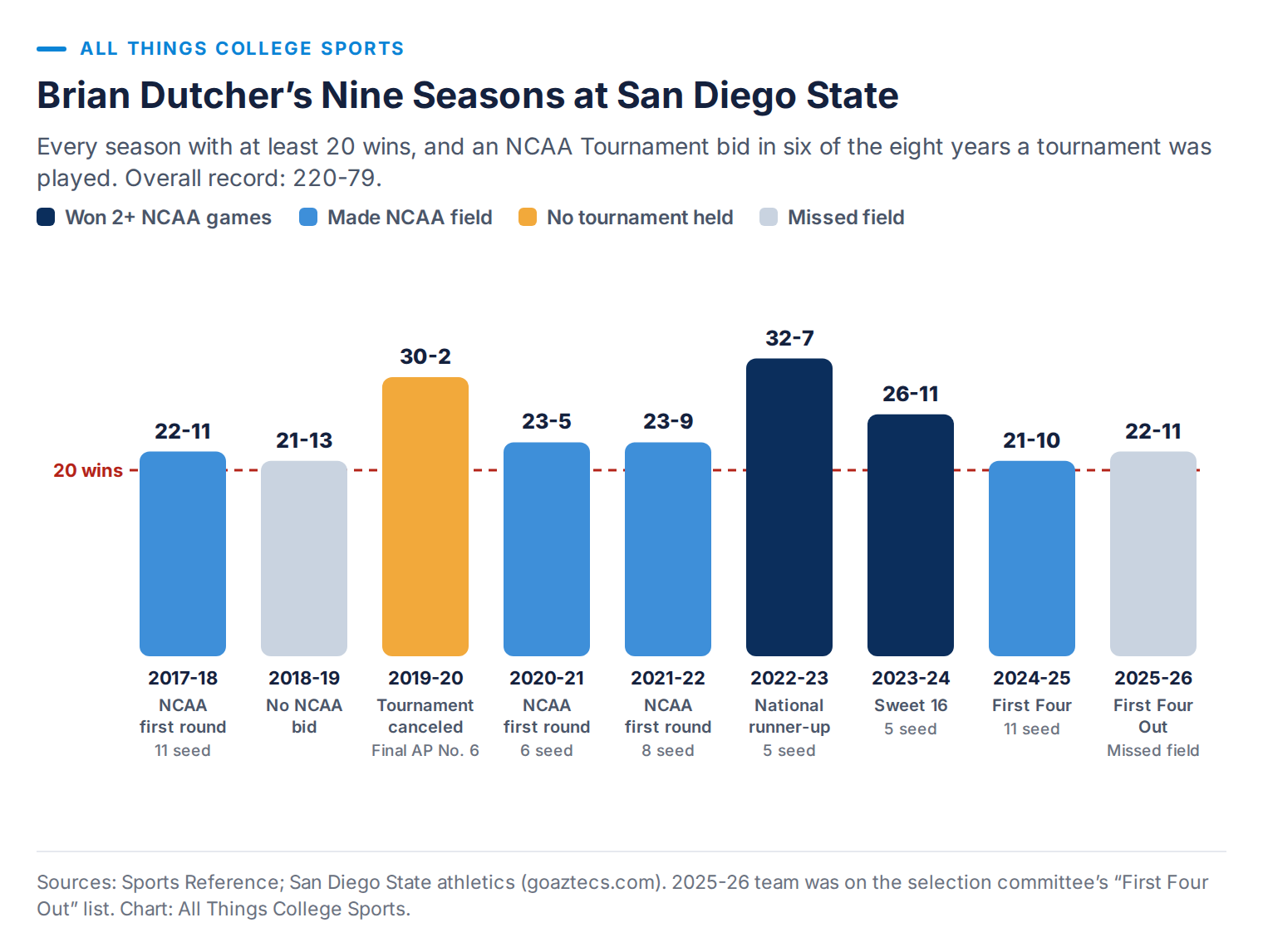
Brian Dutcher doesn't have down years. Dutcher is 220-79 in nine seasons as San Diego State's head coach, the best winning percentage of any coach in program history. He's the only coach in the school's 105-year history to win at least 20 games in each of his first nine seasons, and he has reached the NCAA Tournament in six of the eight years a tournament was played. In 2020, the one year the tournament was canceled, his team was 30-2.
Last season's miss would have been a bid this season. San Diego State went 22-11 and was one of the committee's "First Four Out." "Any other year, this resume was enough," Dutcher said after Selection Sunday. With eight more at-large spots, a résumé like that gets in.
The new league offers more chances. A 16-game Pac-12 schedule means two games against Gonzaga, plus games against Utah State, which has won a first-round game in two of the last three tournaments. Those are exactly the kind of wins the selection committee rewards.
The risk is real. This is the least experienced roster in the top five, and Torvik's projection of 19-9 would leave little room for a bad stretch. But Dutcher has taken nine different rosters to 20 wins. Our call: San Diego State gets one of the 76 spots.
The rest of the board
Saint Mary's (No. 6) has made five straight tournaments, the longest active streak in the pool. Colorado State (No. 7) brings back 61.7% of its minutes, more than any other team in the group. New Mexico, Wichita State and Saint Louis round out the top 10. Saint Louis won a first-round game last March and returns 58% of its minutes, but its experience rating holds it back.
High Point and McNeese show the other way in: a dominant team in a one-bid league. McNeese is projected to go 19-3 in conference play and has made three straight tournaments.
What it means
The 76-team field doesn't guarantee more Cinderellas. Last March, the high-major leagues took 33 of 37 at-large bids, and the new spots could go the same way. But the teams on this list will have more chances to get in, and once they're in, history says some of them will win.
That's the best part of March. The bracket is supposed to belong to the big leagues, yet every year somebody on this list proves it doesn't.
About the data: Projected strength, projected records, returning minutes, and experience ratings come from Bart Torvik's 2026-27 preseason projections (accessed Oct. 29, 2026). The pool is the 20 highest-rated teams outside the ACC, Big East, Big Ten, Big 12, and SEC, excluding Gonzaga. NCAA Tournament appearances and wins for 2022 through 2026 come from Sports Reference; First Four wins count as wins. Each factor is scored as a percentile within the pool and weighted as described above. Dutcher's quote is from Sports Illustrated (March 18, 2026). The index is our own and is not a prediction of the selection committee's decisions.