
College basketball's biggest spenders fill the preseason Top 25 and almost always make the NCAA Tournament. With the field growing to 76 teams this March, the bubble is about to tilt even further their way. Here's what it costs everyone else to crash the party.
Florida opens the season No. 1 in the AP poll for the first time since 2006. According to new reporting from CBS Sports, the Gators' roster is also valued at more than $25 million.
That's not a coincidence anymore. CBS Sports' Matt Norlander and Isaac Trotter spent nearly six weeks talking to more than 100 sources to estimate what all 80 high-major programs will spend on their 2026-27 rosters. The average is $13.5 million, nearly double last season's power-conference average of about $7 million.
Put those numbers next to the new Top 25 and last March's bracket, and one thing is clear: the teams that spend the most are the teams that play in March.
Eighty programs, seven tiers
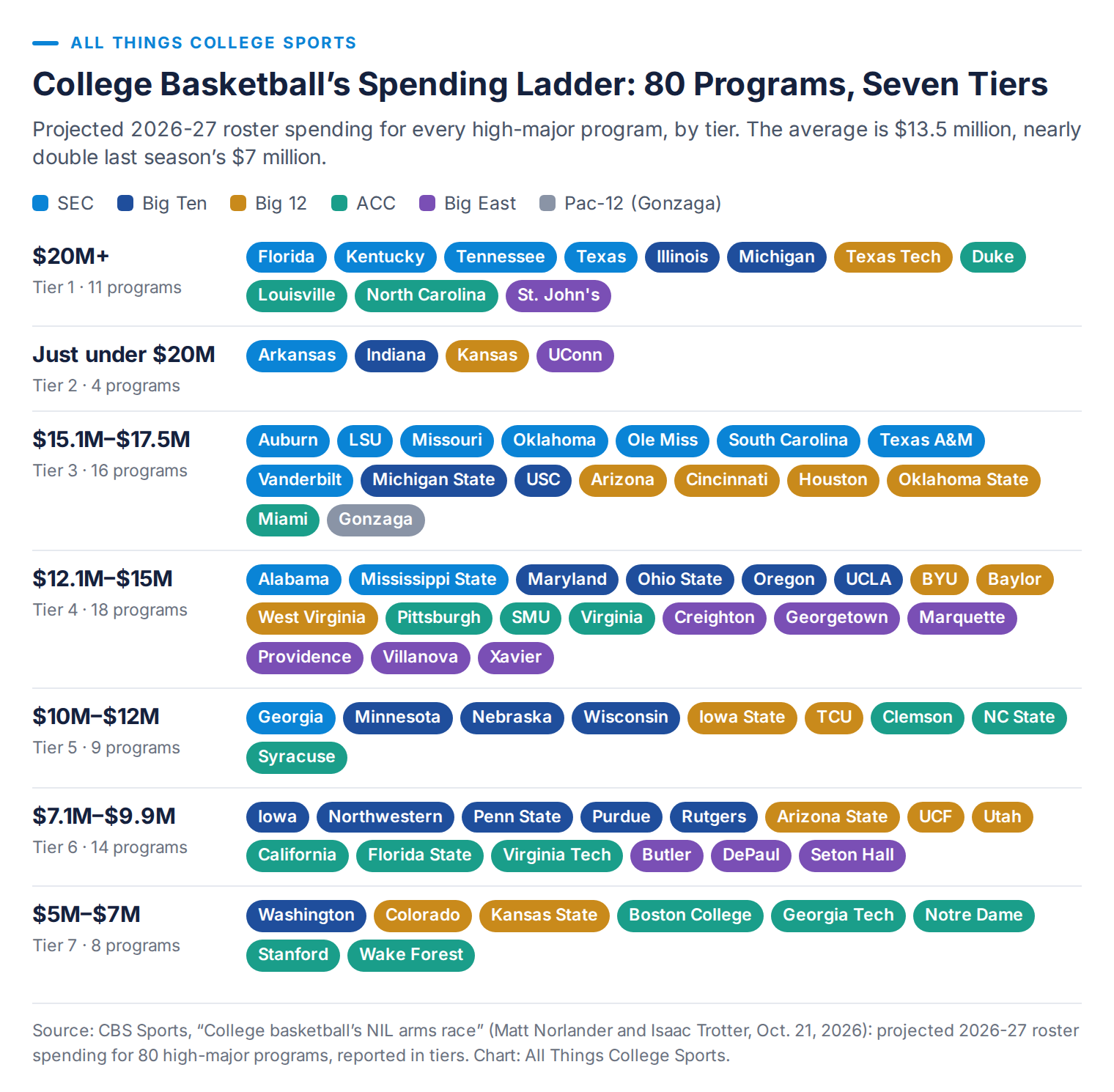
CBS grouped the 80 high-major programs (every school in the ACC, Big East, Big Ten, Big 12 and SEC, plus Gonzaga) into seven spending tiers. Eleven programs are projected to spend $20 million or more: Duke, Florida, Illinois, Kentucky, Louisville, Michigan, North Carolina, St. John's, Tennessee, Texas and Texas Tech.
At the other end, 22 programs will spend less than $10 million. Eight of them cost less than $7 million.
The new Top 25 is loaded with top spenders
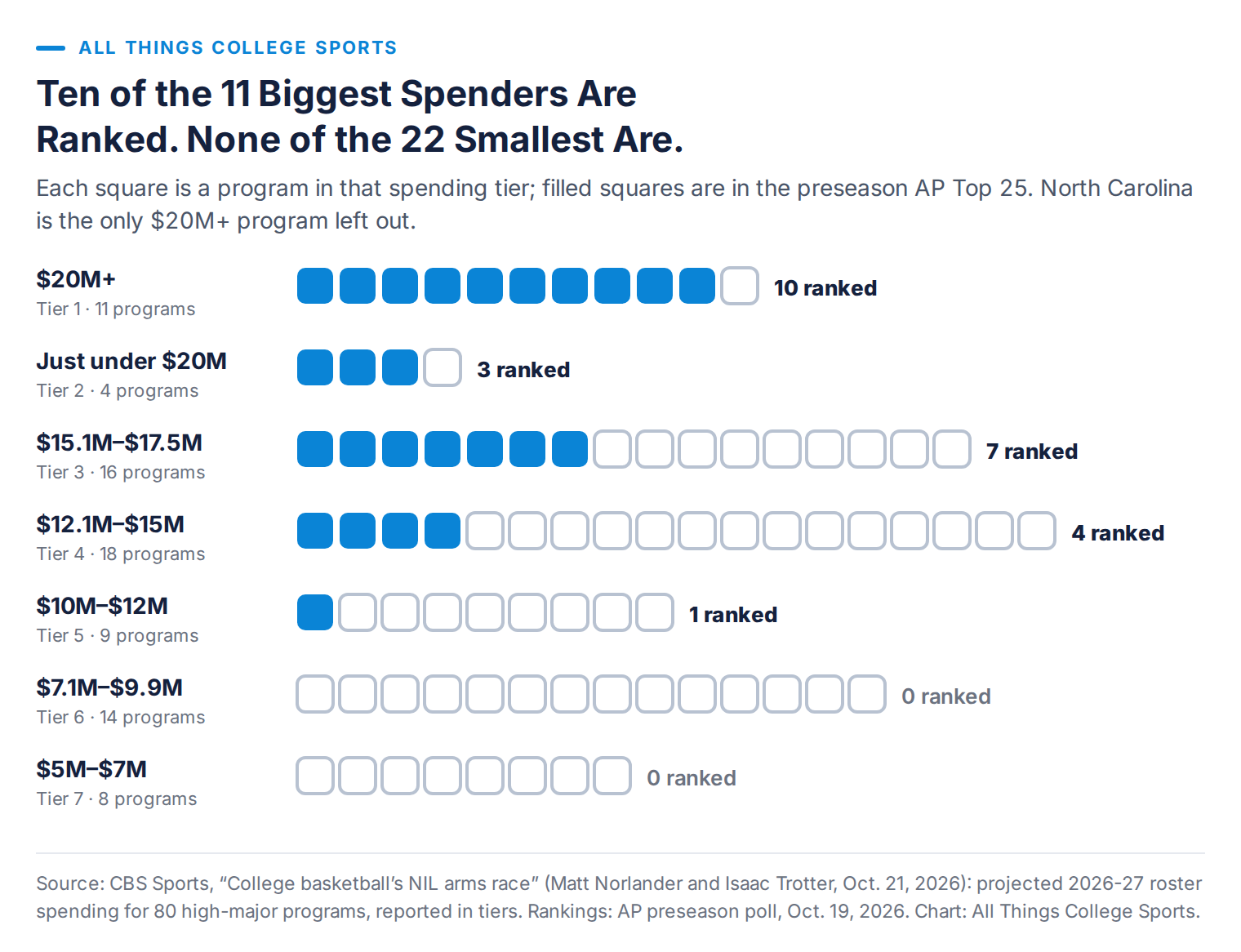
The preseason AP Top 25 reads like a payroll list. Ten of the 11 programs spending $20 million or more are ranked. North Carolina is the only one left out.
Twenty of the 25 ranked teams come from the 31 programs spending at least $15 million. Not one comes from the 22 high-majors spending under $10 million. The lowest-spending ranked team is Iowa State, No. 18, in the $10 million to $12 million tier.
And every team in the Top 25 is one of the 80 high-majors in CBS' survey. No program from outside those leagues made the preseason poll.
Spending predicts the bracket
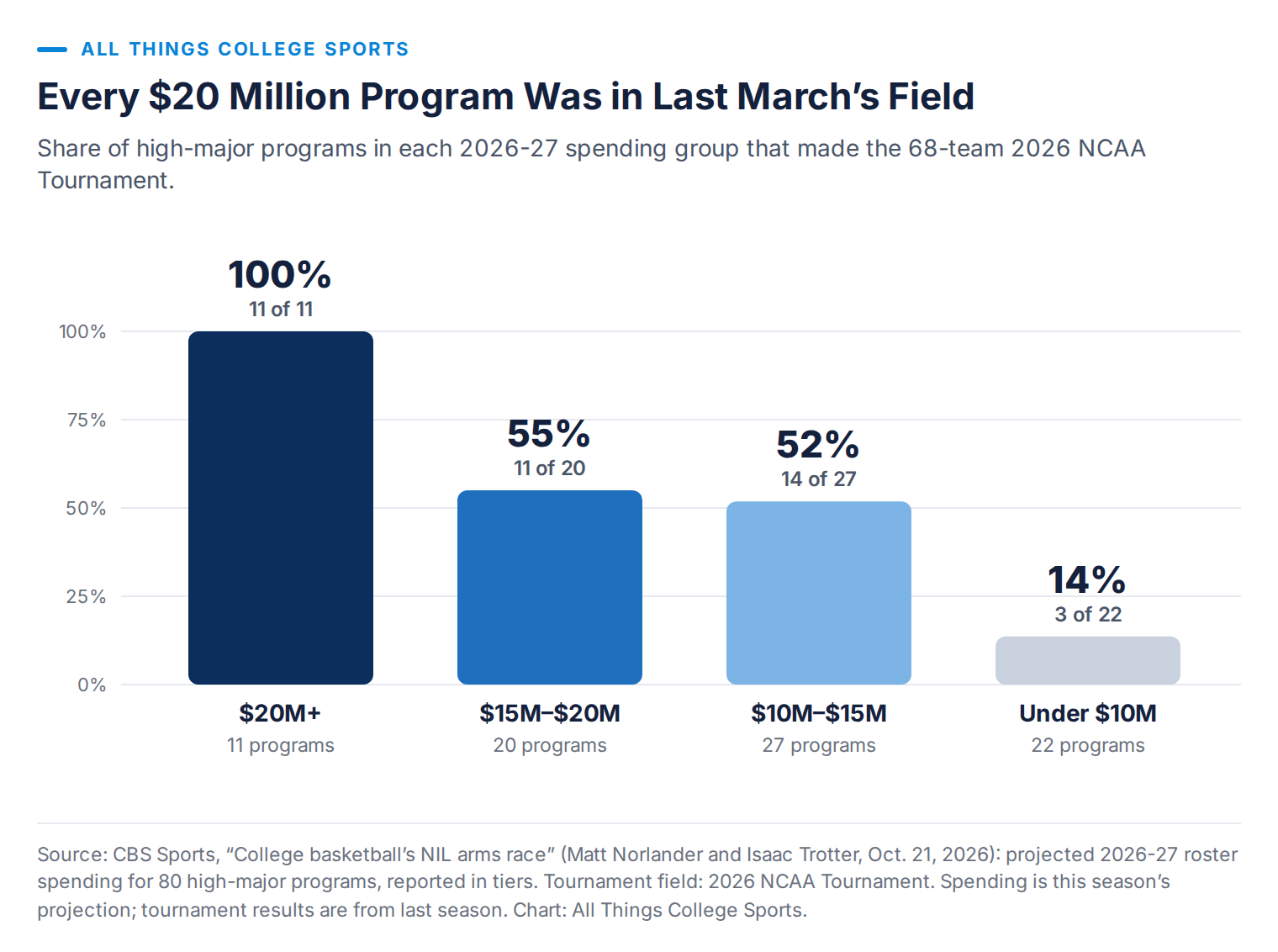
Rankings in October are guesses. The NCAA Tournament field is not, and it tells the same story.
All 11 programs spending $20 million or more this season played in last March's tournament. More than half of the programs in the $10 million to $20 million range did too. Of the 22 high-majors spending under $10 million, only three made the field: Iowa, Purdue and UCF.
The money also decided who stuck around. Last March, the five high-major leagues took 33 of the 37 at-large bids. Five teams from outside those leagues won a first-round game: Gonzaga, VCU, Saint Louis, Utah State and High Point. All five lost the next weekend, and the Sweet 16 was entirely high-major programs.
The expanded field tilts the bubble even more
This season's NCAA Tournament grows from 68 teams to 76. The NCAA approved the change in May, and it starts this March.
The eight new spots are all at-large bids, bringing the total to 44 alongside 32 automatic bids for conference champions. Expansion doesn't add a single extra guaranteed bid for a one-bid league. The new spots go to the bubble.
And the bubble belongs to the spenders. Last March, the selection committee's official "First Four Out" were Oklahoma, Auburn, San Diego State, and Indiana. Three of those four are high-majors, and all three are big spenders this season: Indiana is just under $20 million, and Oklahoma and Auburn are in the $15.1 million to $17.5 million tier. Under a 76-team format, they're in.
For a high-major spending $15 million or more, the bubble just got a lot friendlier. For a mid-major that doesn't win its conference tournament, the margin for error has barely moved.
What it costs a mid-major to compete
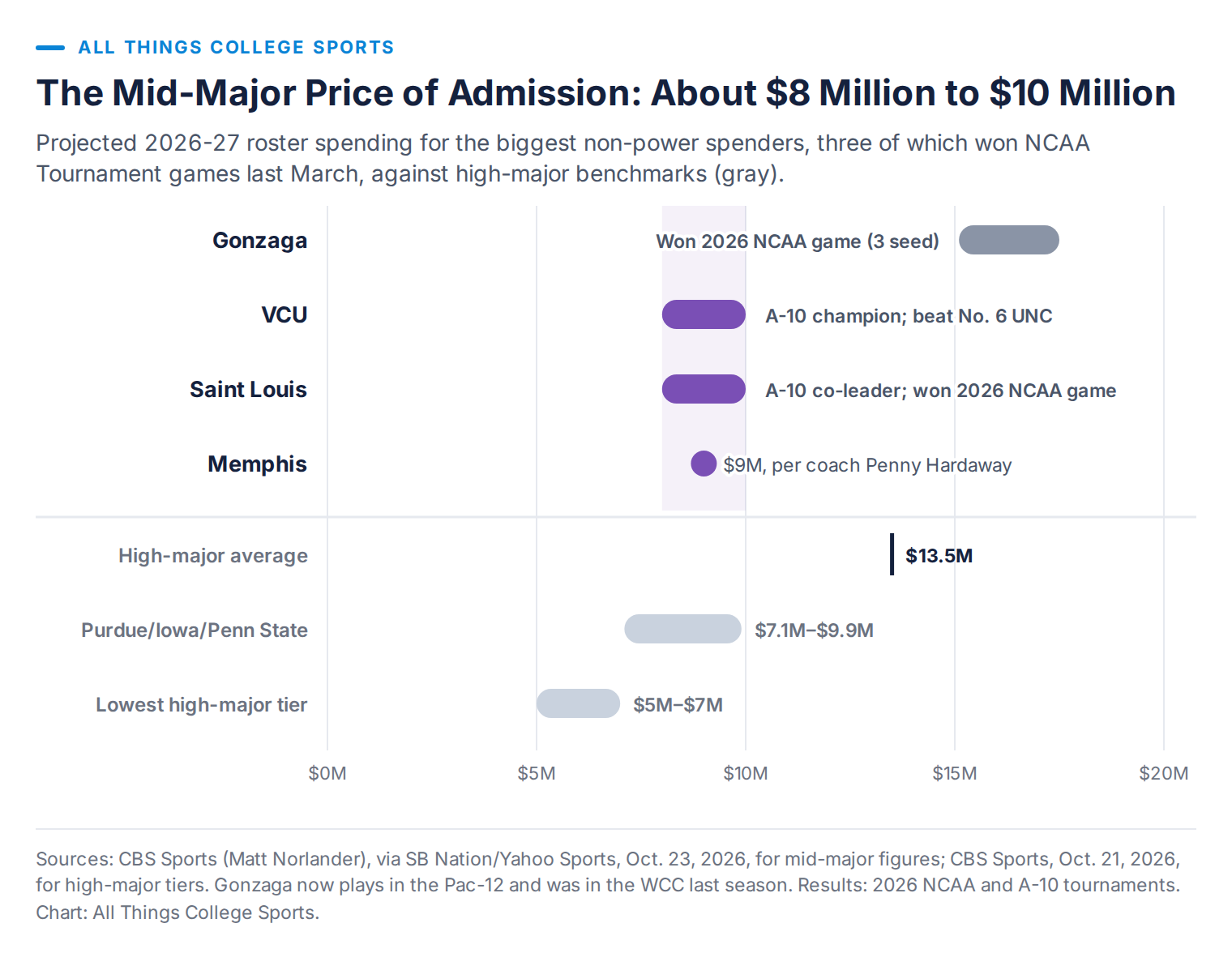
So what does a school outside the high-major leagues have to spend to win its conference and a game in the Big Dance? The best answer right now is about $8 million to $10 million.
That's where the mid-majors that did it last season now sit. VCU won the Atlantic 10 tournament and then came back from 19 points down to beat No. 6 seed North Carolina in overtime. Saint Louis shared the A-10's best league record and also won its first-round game. Norlander puts both in the $8 million to $10 million range for this season. Memphis coach Penny Hardaway has said his roster costs $9 million. Grand Canyon may be the biggest mid-major spender of all; Norlander speculated it could reach $12 million or more.
For context, $8 million to $10 million is about what Purdue, Iowa and Penn State are spending in the Big Ten. It's more than eight high-major programs, including Stanford, Notre Dame, and Wake Forest, which are all in the $5 million to $7 million tier.
That's the multi-bid mid-major price. In a one-bid league, the math is different, and the money matters a little less. High Point, from the Big South, beat No. 5 seed Wisconsin 83-82 last March. Utah State won the Mountain West tournament and a first-round game. Norlander put both a tier below the $8 million to $10 million group, without a specific figure.
What it means
None of this means the tournament is decided in October. Coaching still matters. Fit still matters. Twelve seeds still knock off fives most years, and that's why we love March.
But the odds are stacking up. The biggest spenders are ranked, they're in the field, and, with eight more at-large spots coming, they're about to have more room for error. For everyone else, the price of a real shot keeps rising, and the window to pull off an upset keeps getting smaller.
That's what makes the Cinderella runs that still happen worth watching even more.
About the data: High-major spending tiers come from CBS Sports' projected 2026-27 roster spending for 80 programs (Matt Norlander and Isaac Trotter, Oct. 21, 2026). Mid-major figures come from Norlander's reporting as summarized by SB Nation and Yahoo Sports (Oct. 23, 2026); most are ranges, and Grand Canyon's is his speculation. Rankings are from the preseason AP Top 25 (Oct. 19, 2026). Tournament results and bids are from the 2026 NCAA Tournament. Spending figures are for this season, while tournament results are from last season. The 2026 "First Four Out" list is the selection committee's official list.