
The spending gap between Power 4 programs, and even between schools in the same conference, is too wide for a sustainably competitive environment. A salary cap paired with a floor can fix that problem without shrinking what players earn.
Ohio State and Purdue play in the same conference. They share the same TV contract and can end up on each other's schedule. This season, according to estimates compiled by The Athletic, the Buckeyes will spend roughly $51.5 million on their football roster. Purdue will spend about $18 million.
That isn't what competitive balance looks like.
About the data: Figures are midpoints of The Athletic's estimated 2026 roster-spending ranges for the 67 Power 4 programs (published Sept. 16, 2026; independent Notre Dame is excluded). The estimates cover revenue sharing and school- and booster-driven NIL, and exclude outside national brand deals. The cap-and-floor scenario is illustrative.
The cap we have isn't a cap
Under the House v. NCAA settlement, each school can share up to $21.3 million directly with its athletes in 2026–27. That limit covers every sport on campus, not just football. Third-party NIL money, including booster collectives, sits outside it. Those deals only have to clear the College Sports Commission's NIL Go clearinghouse.
So the current "cap" doesn't cap football spending. By The Athletic's estimates, 45 of the 67 Power 4 football programs spend more than $21.3 million on football alone.
The gap between conferences is real.
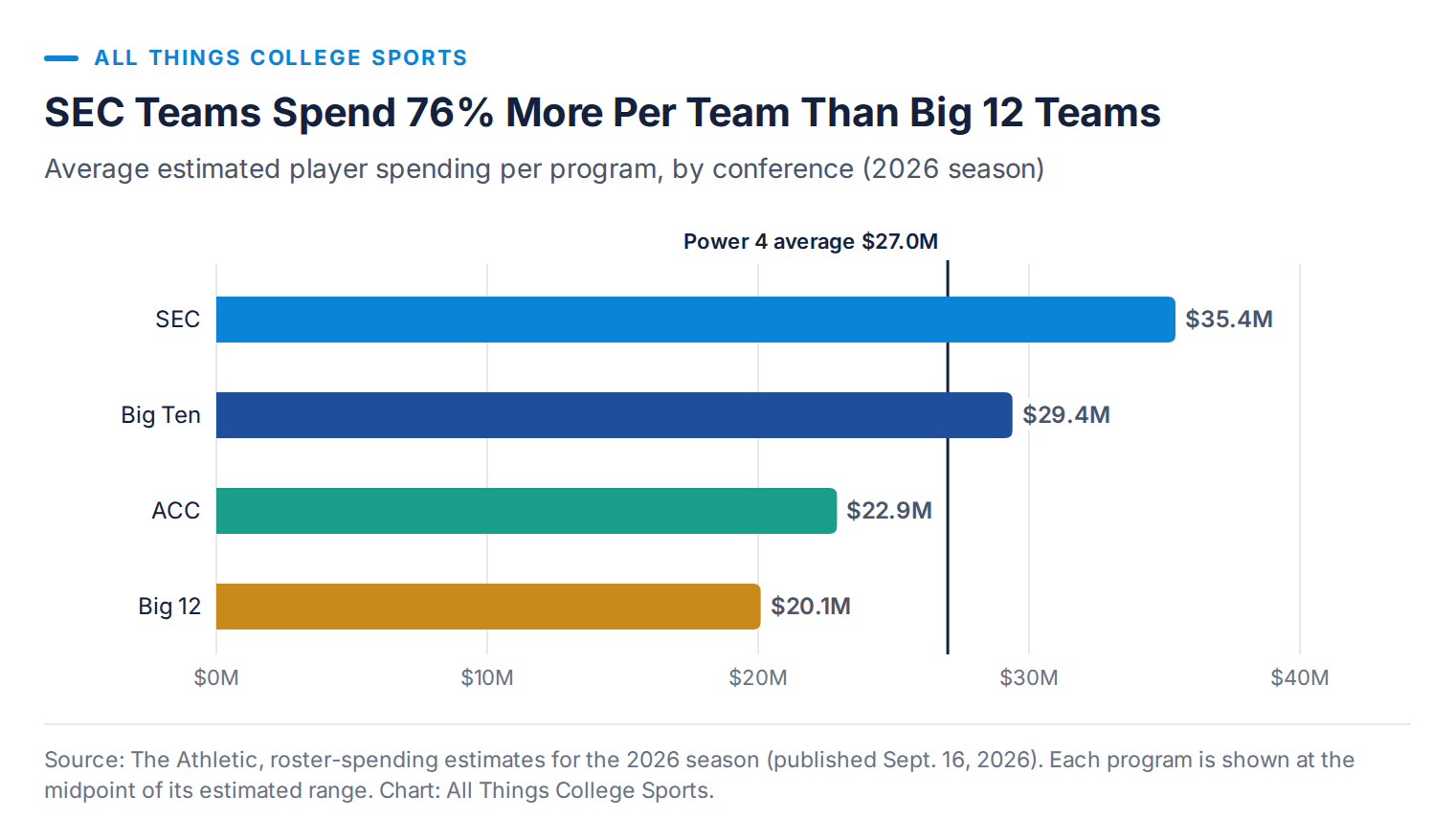
The average SEC program spends an estimated $35.4 million on its roster, while the average Big 12 program spends $20.1 million. That means the average SEC school spends 76% more per team than the average Big 12 school. The Big Ten ($29.4 million) and the ACC ($22.9 million) fall in between, but still sit above the $21.3 million “cap” under the House vs. NCAA settlement.
You might think conference revenue explains the gap, but it doesn't explain all of it.
The gap inside each conference is worse
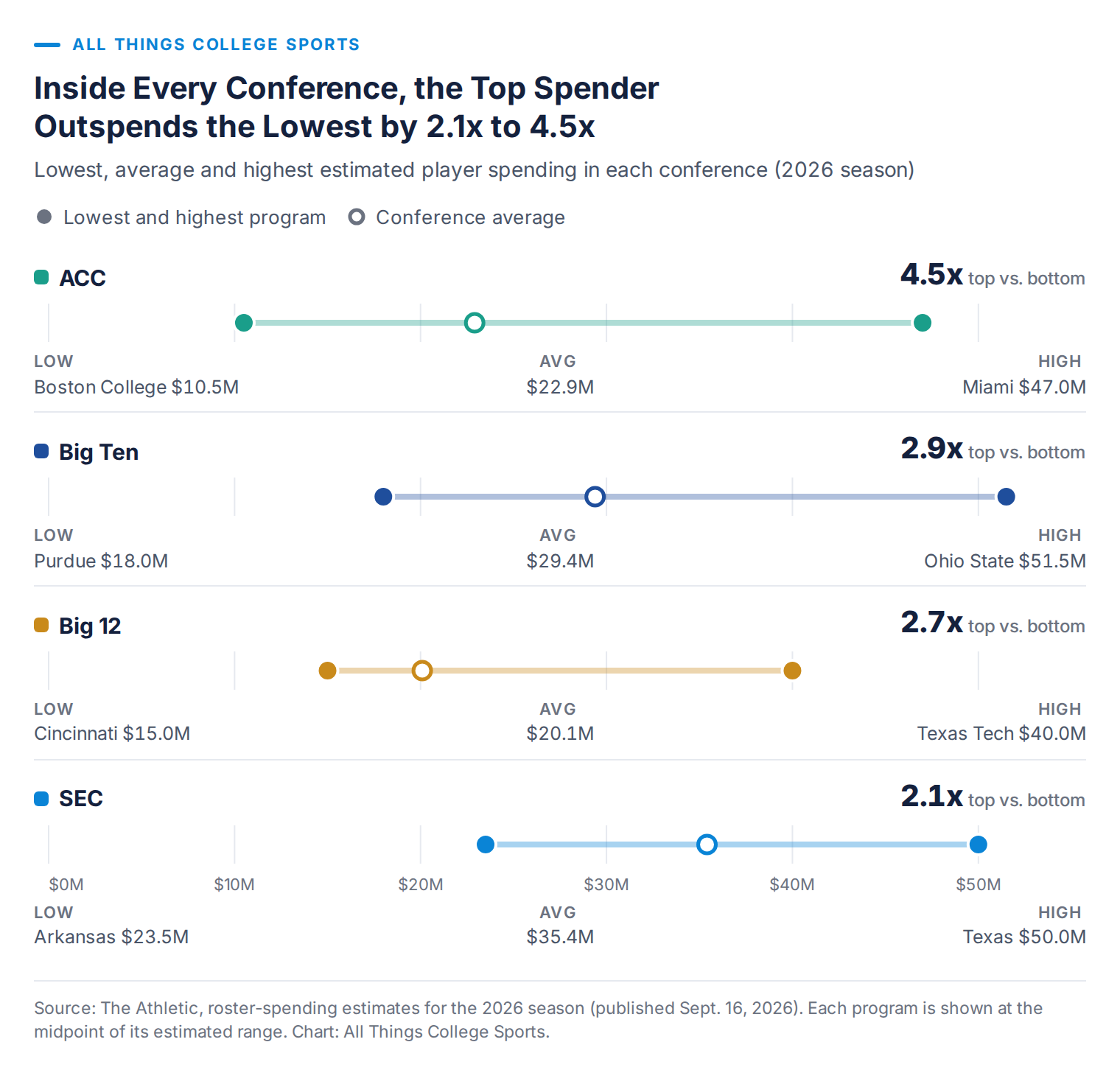
In the ACC, Miami spends an estimated $47.0 million. Boston College spends $10.5 million. That's a 4.5x difference between two teams in the same league. The Big Ten gap is 2.9x (Ohio State vs. Purdue) and the Big 12's is 2.7x (Texas Tech's $40.0 million vs. Cincinnati's $15.0 million). Even in the SEC, the richest conference, Texas outspends Arkansas by upwards of $25 million.
These schools split the same conference media money equally. What separates them is how much booster and collective money each one can raise.
From top to bottom, a 4.9x spread
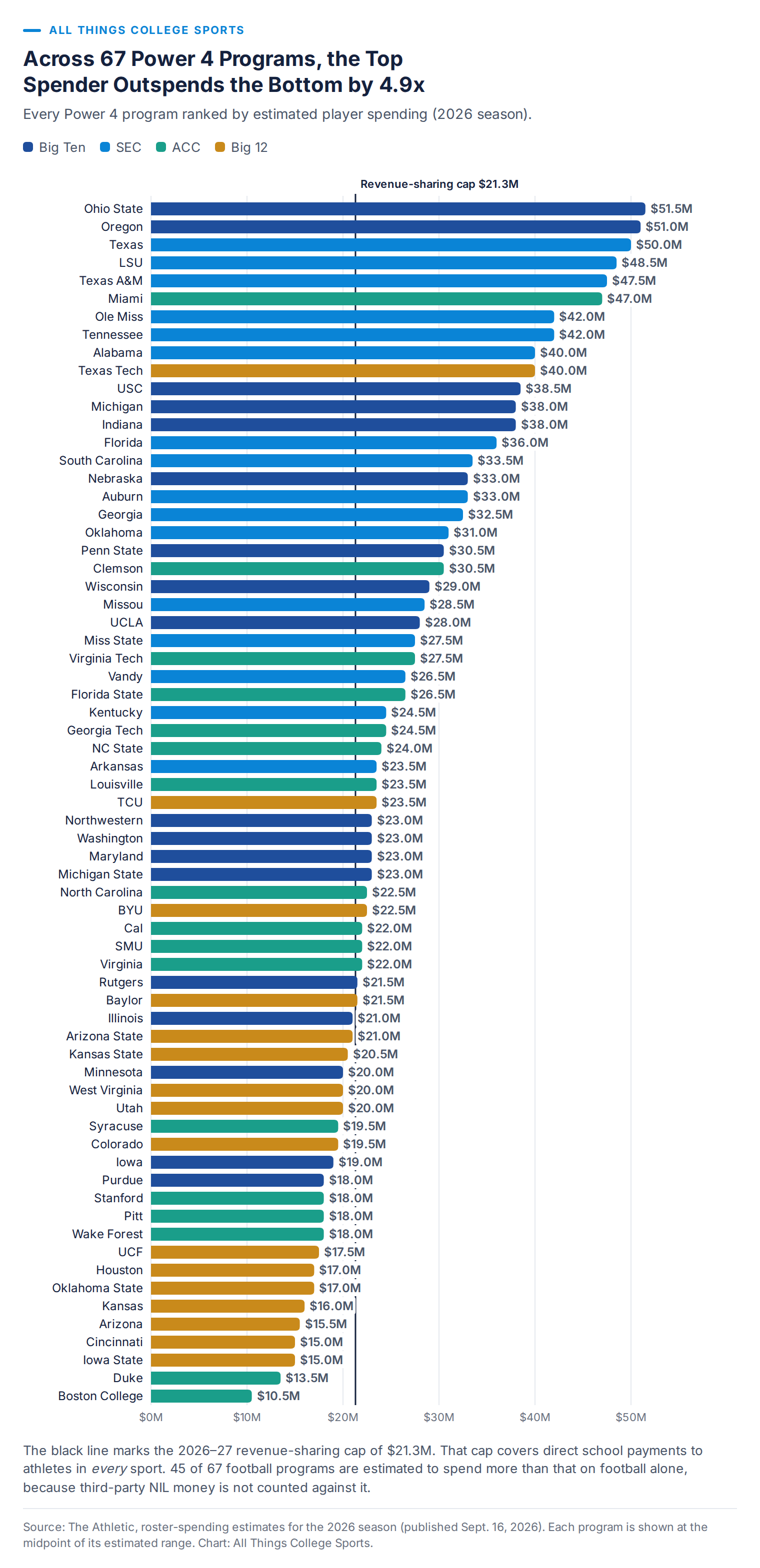
Across all 67 Power 4 programs, the top spender outspends the bottom one by 4.9x. The typical program sits well below the average: the median program spends $23.5 million, while the average is $27.0 million. A small group at the top pulls the average up.
10 programs, 25% of the money
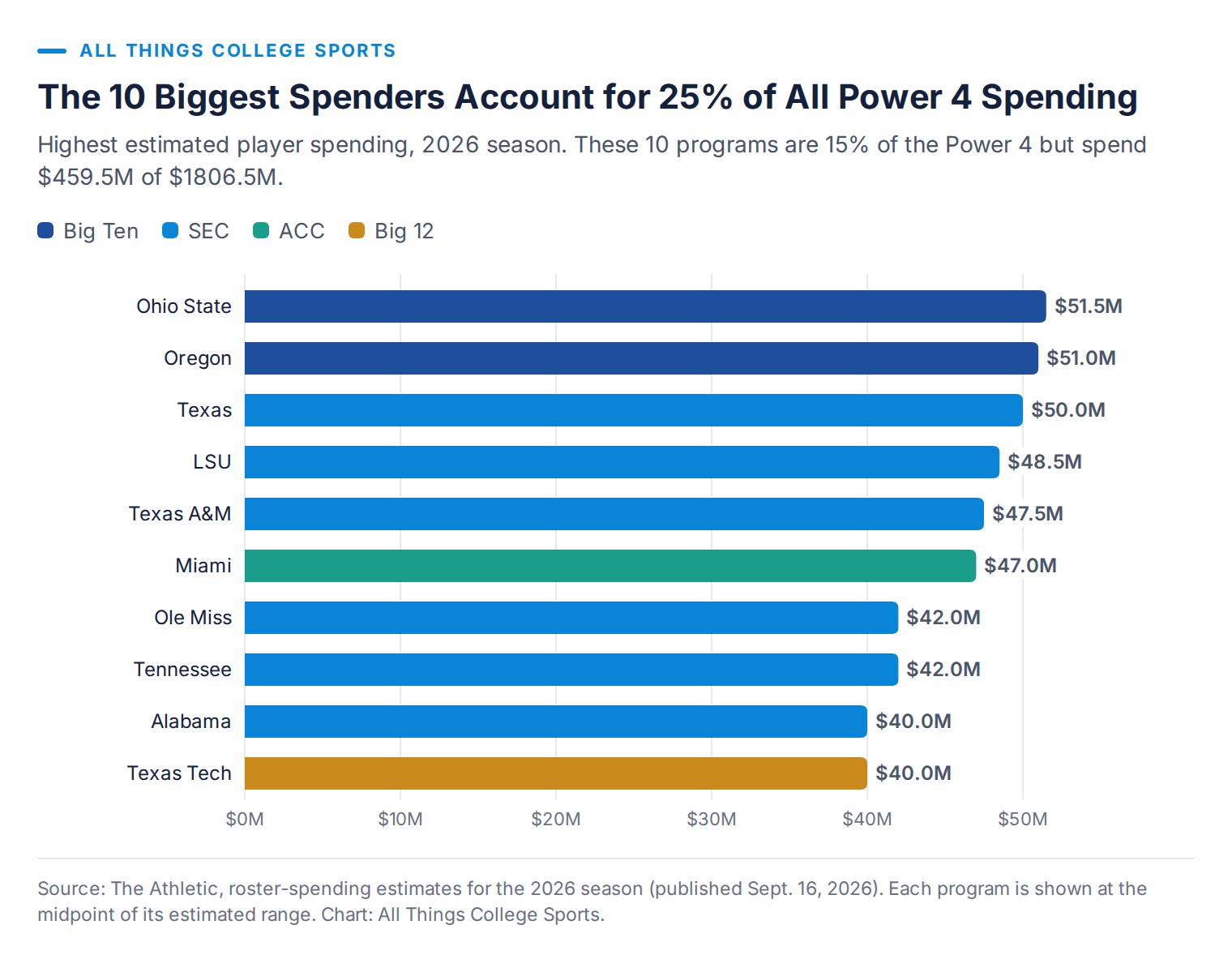
The 10 biggest spenders make up 15% of Power 4 programs but account for 25% of the spending: an estimated $459.5 million of $1.81 billion. The spending lines up with the rankings, too. When The Athletic published its estimates, it noted that eight of the 10 highest-spending teams on its list were ranked in the AP top 10.
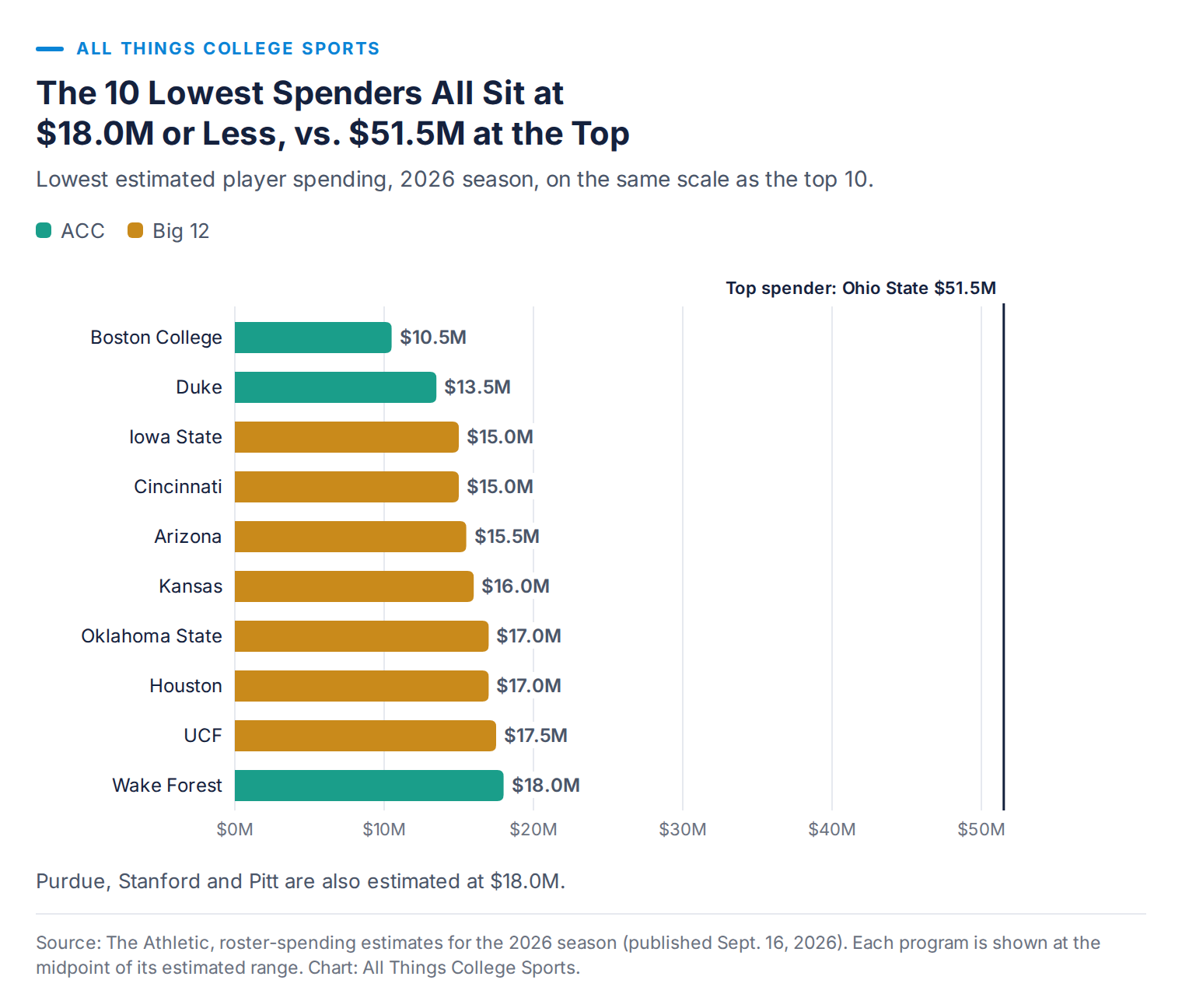
The other end of the list tells the same story. All 10 of the lowest spenders sit at $18.0 million or less, and seven of them are in the Big 12. Boston College could double its spending and still be below the Power 4 median.
Why a cap doesn't mean smaller paychecks
The most common objection is that a salary cap is just a way to pay players less. It doesn't have to be. Here's why.
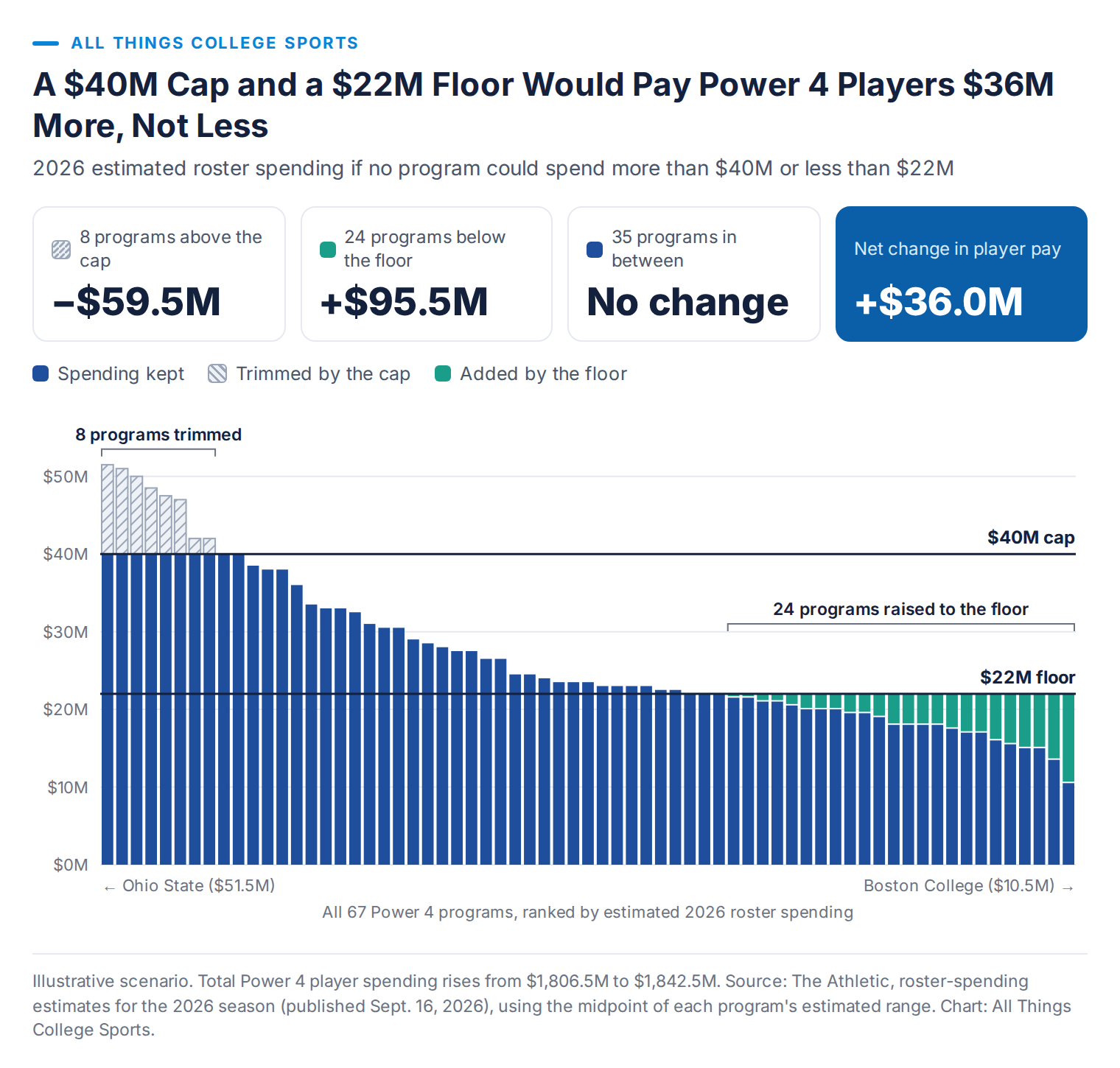
A cap limits what one team spends, not what the sport spends. Pair it with a floor and money moves toward the programs that spend the least. Here's a rough illustration using The Athletic's midpoint estimates. With a $40 million cap and a $22 million floor, the eight programs above $40 million would trim a combined $59.5 million. The 24 programs below $22 million would add $95.5 million. The other 35 programs wouldn't change at all. Net result: Power 4 players would collectively earn about $36 million more, not less.
Pro sports prove that caps and rising pay can coexist. The NFL has had a hard cap since 1994. For 2026, it is $301.2 million per team, which is more than double the 2011 figure. A revenue-tied cap grows as the sport grows.
The NFL has a floor, too. People often describe the NFL as a cap-only league, but it isn't. Its collective bargaining agreement also requires every team to spend at least 90% of the salary cap in cash over each multi-year period. The current period runs from 2024 through 2026. A team that falls short has to pay the difference directly to its players. The floor keeps a low-budget owner from pocketing league revenue while fielding a cheap roster.
Every NFL team can meet that floor because the league splits its national TV money equally.
College football does not currently have an equalizer like that. Conference media money is shared, but the money driving the spending gap is booster and collective NIL money, and it stays with the school that raised it. That's why a cap alone won't work. A $40 million cap would stop Ohio State from spending more, but it would do nothing for Boston College at $10.5 million. The top would come down, the bottom would stay where it is, and players would lose $59.5 million overall. A floor is what turns a cap from a spending limit into a system that moves money toward the players and programs that have been left behind.
How the schools below the floor get there
The biggest objection to a floor is simple: where does the money come from? The answer starts with how small the gap is for most of these schools.
The gap is smaller than it looks. With a $22 million floor, 24 programs would need to spend more, for a combined $95.5 million. That works out to about $4 million per school. Eleven of them are within $3 million of the floor, and only six are more than $5 million short. No SEC program is below it. The Big 12 carries most of the load: 13 programs need a combined $50.5 million. Boston College has the biggest climb at $11.5 million.
1. Phase it in. Start the floor at $18 million, raise it to $20 million the next season, and reach $22 million in year three. That spreads the cost out. The shortfall across the Power 4 would be $25 million in year one, $53 million in year two, and $95.5 million in year three. Schools get time to grow donor bases and collectives before the full floor applies.
2. Measure it over several seasons, the way the NFL does. The NFL doesn't require teams to hit 90% of the cap every year. It measures spending over multi-year periods. College football could do the same by requiring a program's average over three seasons to reach the floor. That gives schools room for a lean year after a big recruiting class or a coaching change.
3. Enforce it the NFL way. If a school still falls short at the end of the period, it pays the difference directly to the players on its roster, just as NFL teams must. The floor isn't a fine that disappears into a league office. Every dollar of shortfall ends up with the players.
4. Hold back a slice of conference money. Conferences already split media revenue among their members. Setting aside a small share as a "floor fund" would let a league top up its own schools. In the Big 12, that's about $3.9 million for each of the 13 schools below the floor. A conference that wants its title game to mean something has a reason to pay it.
5. Let the top pay for the bottom. Instead of simply blocking spending above $40 million, charge a tax on every dollar over it and send that money to programs below the floor. The NBA and MLB both use luxury taxes to discourage runaway spending.
A school that still can't reach the floor after a phase-in, a luxury-tax payout and conference support faces a fair question: should it compete at the Power 4 level at all?
What it would take
None of this is simple. A limit on third-party NIL money invites antitrust challenges unless it's collectively bargained or protected by federal law. The Protect College Sports Act, which recently advanced in the United States Senate, would write the House settlement's pay limits into law and shield schools and conferences from antitrust suits over compensation rules. The House isn't expected to take it up before the November election.
A real cap would also have to count all player compensation, meaning both revenue sharing and collective-funded NIL, while leaving genuine outside endorsements alone. The infrastructure to do that already exists. NIL Go has declined to clear more than 1,800 deals worth nearly $90 million since it launched, which shows outside money can be tracked and reviewed.
The point is Saturday
A cap won't turn Purdue into Ohio State, and it shouldn't. Some programs will always have more history, bigger stadiums, and louder fan bases. But when one team in a conference spends nearly three times as much on players as another, the outcome is all but settled before kickoff. A cap with a floor keeps players paid and gives every program in the Power 4 a real shot to compete every Saturday.