
Ohio State and Oregon can match anyone's roster budget. Below them, the Big Ten's spending drops off a cliff; its old middle class is losing, and the standings are splitting in two. The SEC's money runs all the way down.
At the very top, the Big Ten doesn't trail anybody. Ohio State spends an estimated $51.5 million on its football roster, and Oregon spends $51 million, according to The Athletic's 2026 estimates. Those are the two biggest budgets in the Power 4. No SEC program spends more.
Go one spot further down the list, though, and the comparison flips. From the third-biggest spender in each conference to the 16th, the SEC spends more at every single position. And the further down you go, the less the Big Ten looks like the SEC's equal.
Rank for rank, the SEC spends more
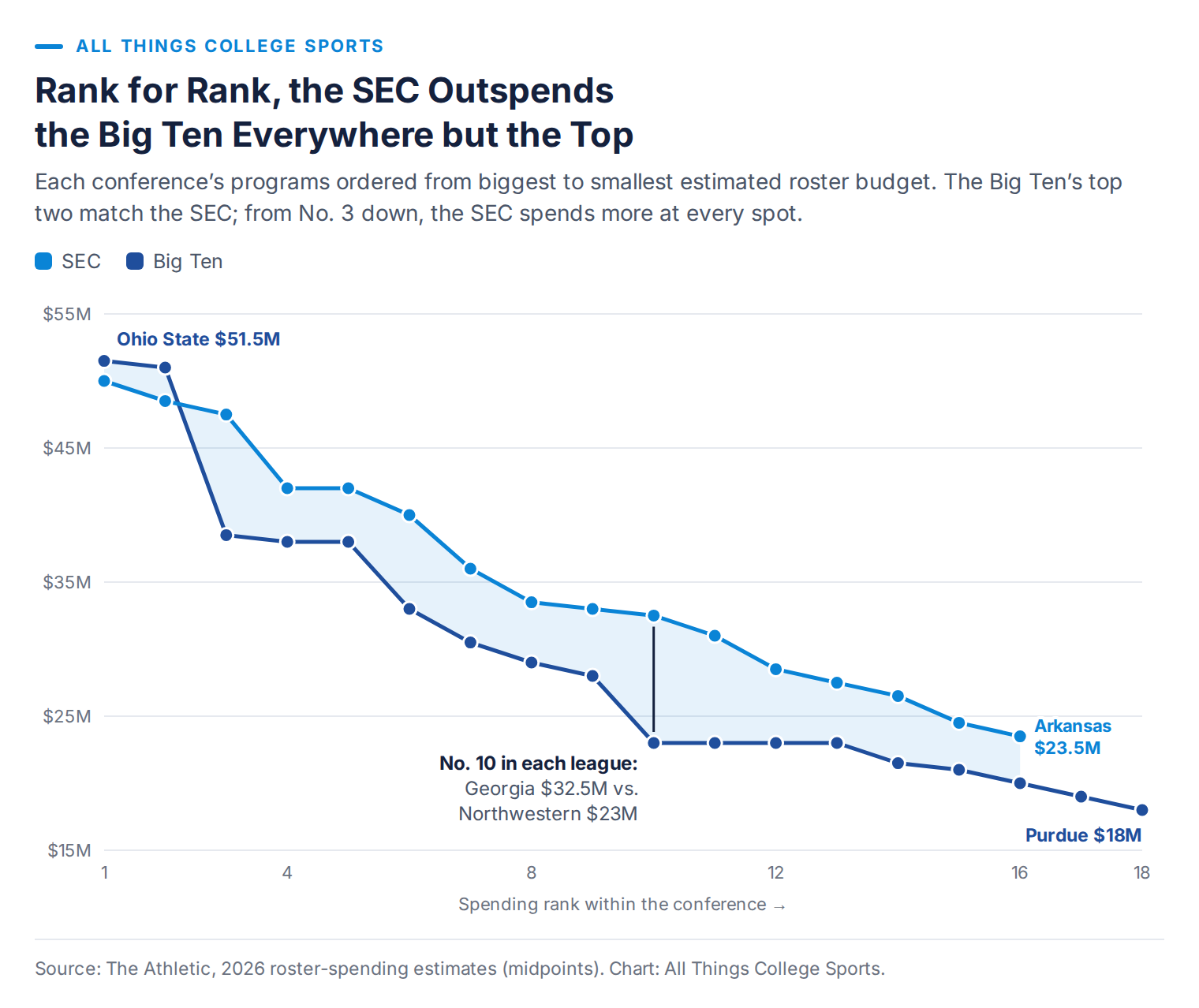
Line up each conference's programs from biggest budget to smallest and the gap is hard to miss. The SEC's third-biggest spender, Texas A&M, spends $47.5 million. The Big Ten's USC spends $38.5 million.
The gap is widest in the middle. Georgia is the SEC's 10th-biggest spender at $32.5 million. The Big Ten's 10th, Northwestern, spends $23 million. That's a $9.5 million difference between two teams in the same spot in their leagues' pecking order.
The SEC's floor is the Big Ten's middle
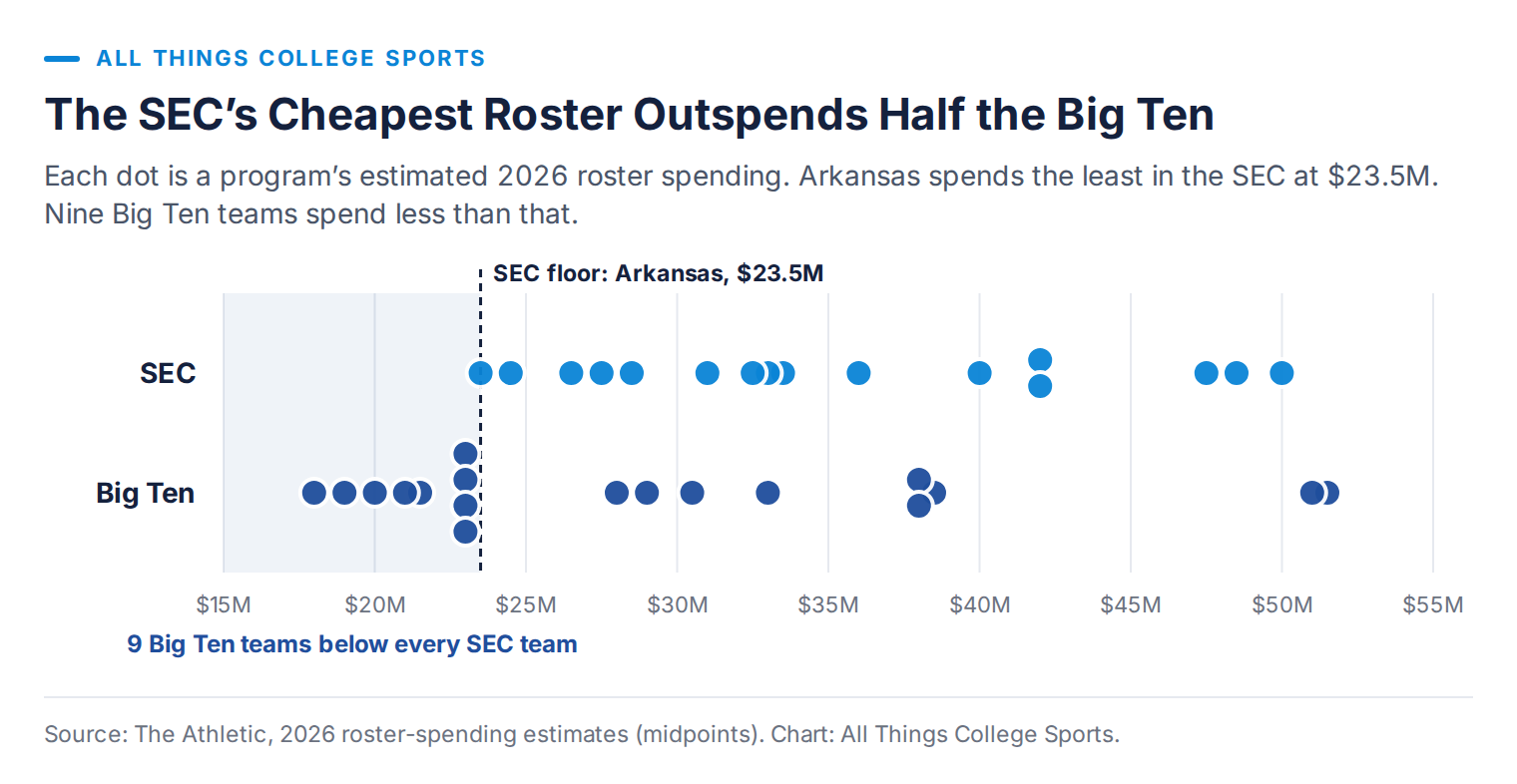
Arkansas spends the least of any SEC team, an estimated $23.5 million. Nine Big Ten programs spend less than that: Northwestern, Washington, Maryland, Michigan State, Rutgers, Illinois, Minnesota, Iowa, and Purdue.
In other words, the cheapest roster in the SEC would rank 10th in the Big Ten. Half of the Big Ten operates below a line no SEC school goes under.
Overall, the SEC's median program spends $33.3 million. The Big Ten spends $25.5 million.
The standings are splitting the same way
Money doesn't decide every game, and we wrote about that in our first article. But across a full league, it shows up.
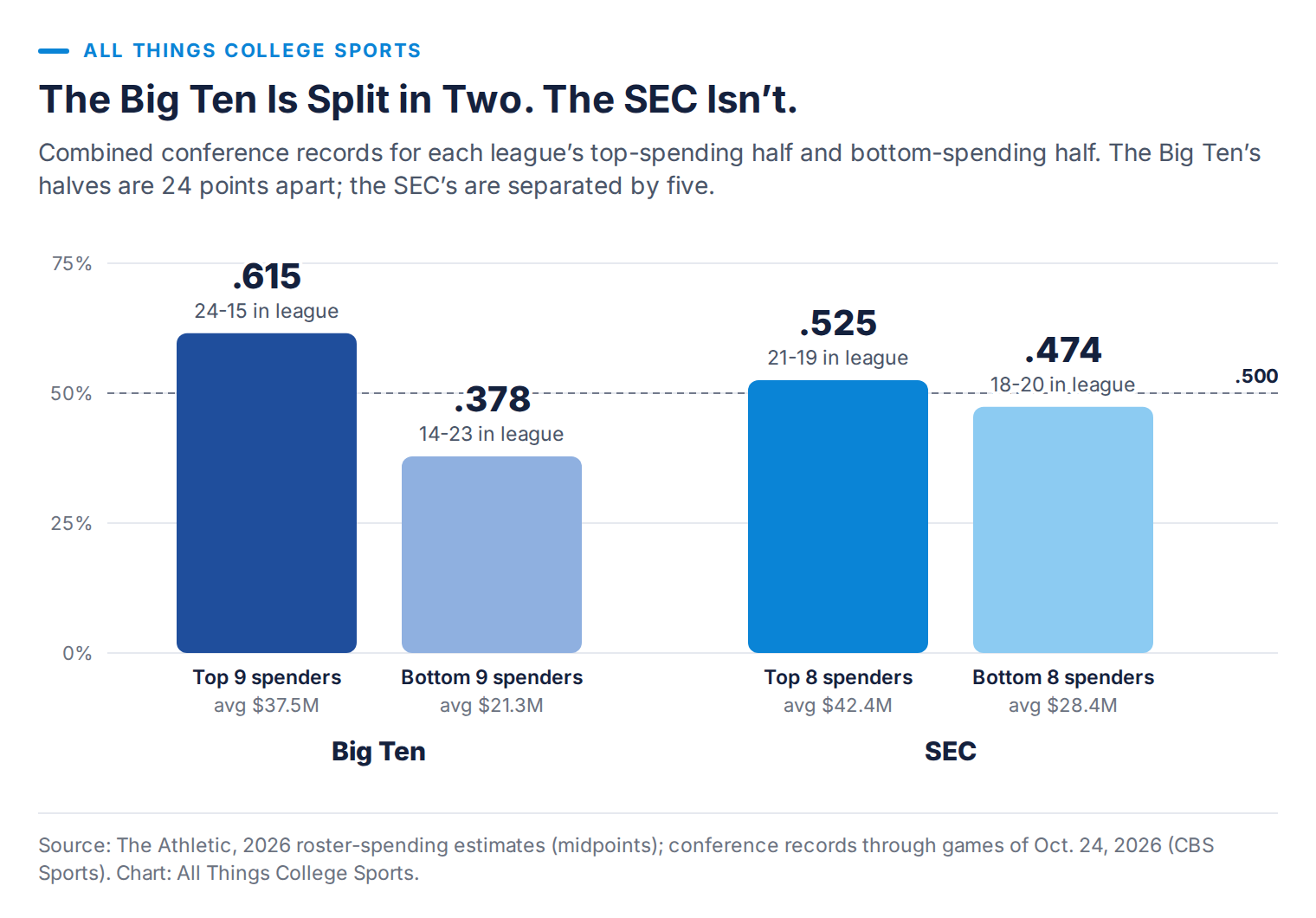
Split the Big Ten in half by spending. Through games of Oct. 24, the nine biggest spenders are a combined 24-15 in conference play, a .615 winning percentage. The nine smallest spenders are 14-23, a .378 mark.
Do the same in the SEC and the gap nearly disappears. The top eight spenders are 21-19 in league play (.525). The bottom eight are 18-20 (.474).
That's what depth looks like. When the 16th-biggest budget in your conference is still $23.5 million, nobody is overmatched on paper. Kentucky, which spends $24.5 million, the second-lowest figure in the SEC, leads the league at 5-1. Texas A&M, at $47.5 million, is 1-4. In the SEC, any team can beat any other team, and on Saturdays they do.
The Big Ten's middle class is losing
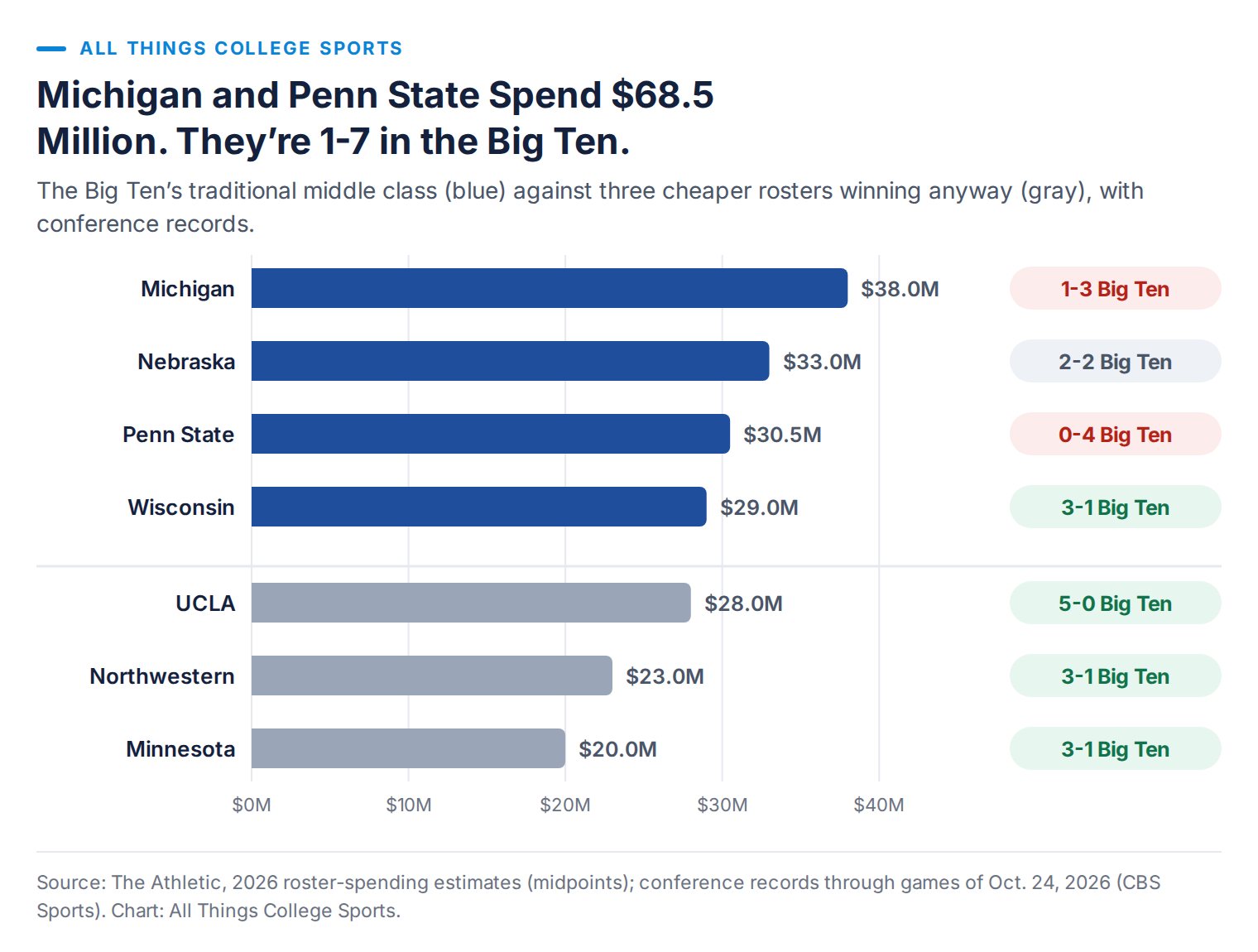
The biggest problem in the Big Ten isn't the bottom; It's the programs that used to be the league's backbone.
Michigan won the national title three seasons ago. Penn State reached the College Football Playoff semifinals two seasons ago. Both changed coaches in the offseason: Kyle Whittingham at Michigan, Matt Campbell at Penn State. Together, they spend an estimated $68.5 million on their rosters. Together, they are 1-7 in the Big Ten. Penn State is 0-4 in conference play.
Nebraska, at $33 million, is 2-2 after a 4-0 start.
Wisconsin is the exception. At $29 million, the Badgers are 3-1 in the league, including a 24-20 win over Penn State.
The teams filling the gap aren't spending their way there. UCLA ($28 million) is 5-0 in the Big Ten and 7-0 overall. Northwestern ($23 million) and Minnesota ($20 million) are both 3-1. Those are good stories, and the kind we love here. But when Michigan and Penn State, two longtime powerhouses, are a combined 1-7, they don't have the depth to match the SEC week after week.
What it means
The Big Ten's best can still beat anyone. Ohio State is 4-0 in conference play and No. 2 in the AP poll. But the league's money is concentrated at the top, and its standings are following.
The SEC's money is spread out. That doesn't make the SEC's best teams better than Ohio State. It makes its middle tougher, its bottom more dangerous, and its Saturdays harder to predict.
It's also another reason we've argued for a spending floor. A floor would push the Big Ten's bottom half closer to where the SEC already is. Right now, nine Big Ten programs are playing a different financial game than the rest of their own league, and their 14-23 conference record shows it.
About the data: Spending figures are midpoints of The Athletic's estimated 2026 roster-spending ranges (published Sept. 16, 2026), covering revenue sharing and school- and booster-driven NIL. Conference records are through games of Oct. 24, 2026, per CBS Sports. Spending halves: Big Ten top nine and bottom nine of 18; SEC top eight and bottom eight of 16. AP ranking is from the Oct. 25 poll.